Fill this in once. Every directory form becomes a paste job.
Every launch platform asks for the same dozen things in a slightly different order: a name, a tagline under some character limit, two or three descriptions, a square icon, a handful of gallery images, a maker bio. Founders retype them thirty times; the pack is the fix: one folder and one text file you prepare before touching a single form.
Below is the template, every step explained. And because a template without a worked example is homework, each step is filled in with SubmitMap's own live pack: the real tagline, the real copy, the real files, all downloadable.
And you don't have to do the pasting yourself. Once the pack exists you can teach your AI agent to submit for you: connect it over MCP and it gets each form's brief with these answers already in it.
01Name, URL and tagline
The tagline is the most reused string in the pack: it becomes your Product Hunt tagline, your directory listing subtitle, your meta description opener. Write it once to the strictest limit you'll ever meet, 60 characters, and it fits every form after that without editing.
- - Say what the product is, not what it revolutionises.
- - No trailing period, no exclamation mark, no Title Case Shouting.
- - The URL you submit is the canonical one: https, no trailing UTM junk.
- - An address you actually read. Most forms ask for one, and it is where the confirmation link lands.
02Three lengths of description
Three sizes cover every field you will ever meet. Write the short one first: it forces you to decide what actually matters. Then expand it into the long one and compress it into the one-liner.
- - One-liner (≤140 chars): for "describe it in one sentence" fields and meta descriptions.
- - Short (≤260 chars): the Product Hunt description budget; the string you'll paste most.
- - Long: two or three honest markdown paragraphs for directories with rich pages. No keyword stuffing; reviewers read these.
800+ directories, who each one accepts, and an agent that submits only where you qualify.
SubmitMap lists 800+ startup and SaaS directories with the rules that decide who each one accepts: what gets rejected, the exact steps, approval time and dofollow status. Free to browse, no account. An agent then submits, only where you qualify.
Every launch guide says "submit to directories". None of them say which ones accept your kind of product, what the form will ask, or what actually happens after you hit submit.
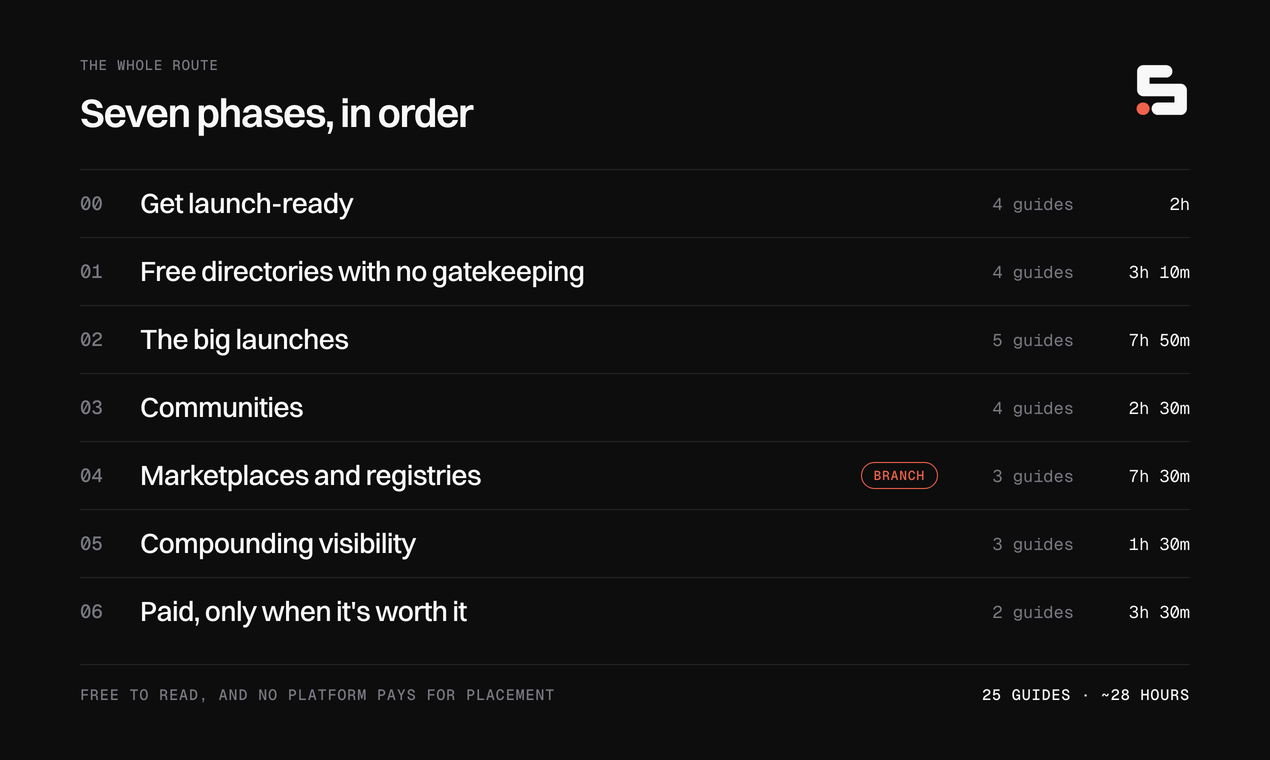
SubmitMap is that missing map, 800+ platforms and counting. Every platform is a typed record: who it accepts, what disqualifies you, the exact submission steps, expected approval time and whether the backlink is dofollow. The route organises it all into seven phases, from getting launch-ready to the paid channels you should only open last. Connect it to your AI over MCP and it works out what you qualify for and fills the forms in your own browser. It does not blast every directory: a submission you were never eligible for is just a rejection you waited a month for.
No paid placement, ever. Reading the directory needs no account; editorial usefulness is the whole moat.
03Logo, icon and favicon
Five files cover every icon field in existence: an SVG master, a 1024px PNG export of it, both again in a dark variant, and the bare mark as a favicon. Directories that never ask for an icon scrape your favicon instead, so it ships in the pack too.
- - The mark must survive 32px. Zoom out until it's tiny; if it mushes, simplify.
- - Square canvas, generous padding, one corner radius, and never text in the icon.
- - Forms want "PNG, at least 240/512px": the 1024 export downsizes to all of them.
 Favicon (the bare mark)SVG, square crop of the mark aloneBrowser tab; directories that scrape your favicon as the listing icon
 App icon (light)SVG · 88×88 grid, 21px corner radiusThe master icon. Forms that accept SVG get this
 App icon (dark)SVG · same grid, dark tileDark-mode directories and dark gallery slides
 App icon (light, raster)PNG · 1024×1024Every form that wants "square PNG, at least 240/512px"
 App icon (dark, raster)PNG · 1024×1024Same forms, when the page behind the icon is dark
04Gallery frames
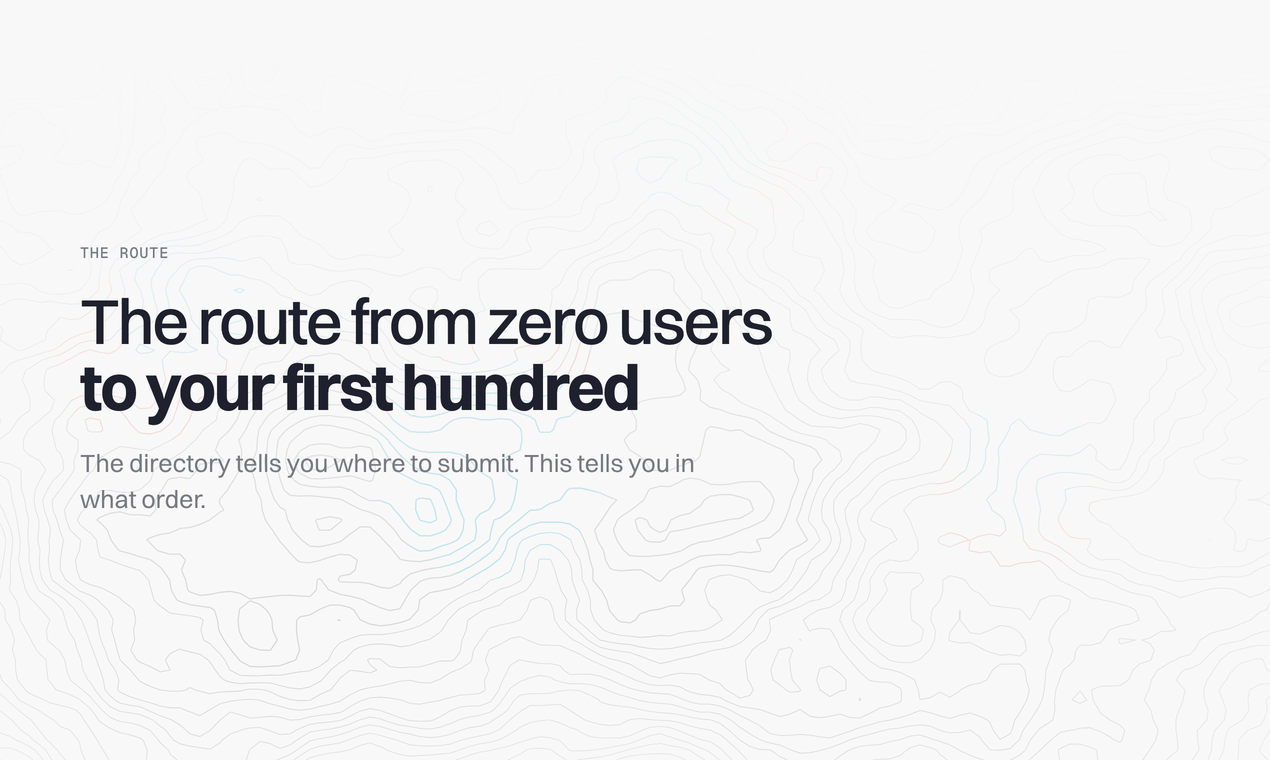
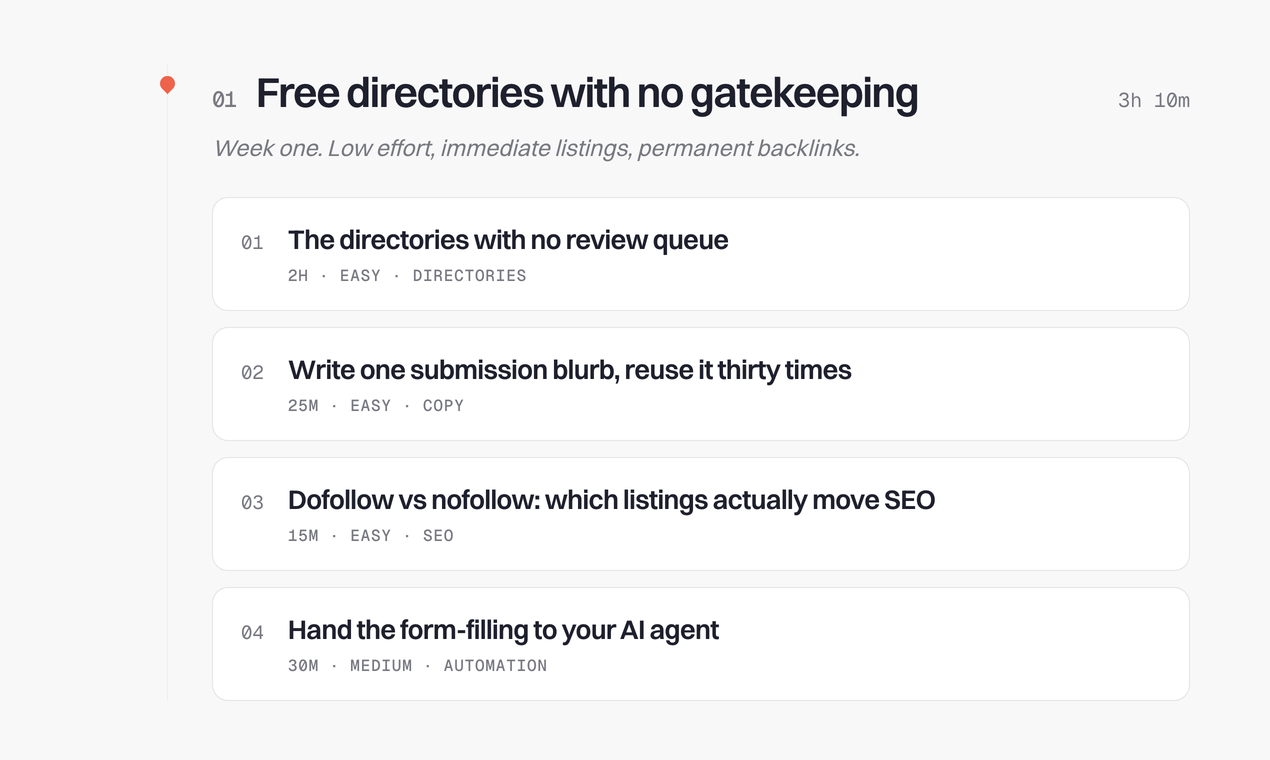
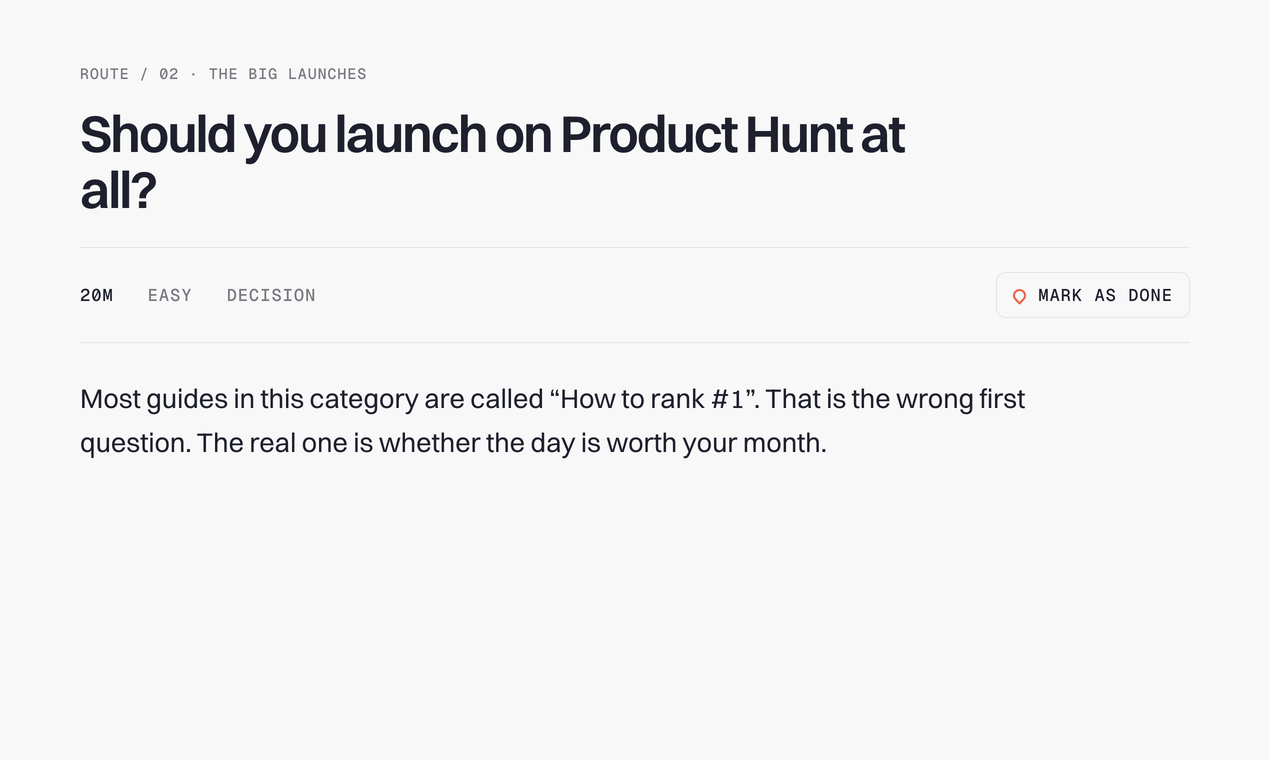
Make them once at 1270×760, the Product Hunt size that every other platform accepts, and you never crop again. Three to five frames, in a deliberate order: a poster to open, real product frames in the middle, a closing slide that states the promise. Raw screenshots are the weakest possible gallery.
05The OG image
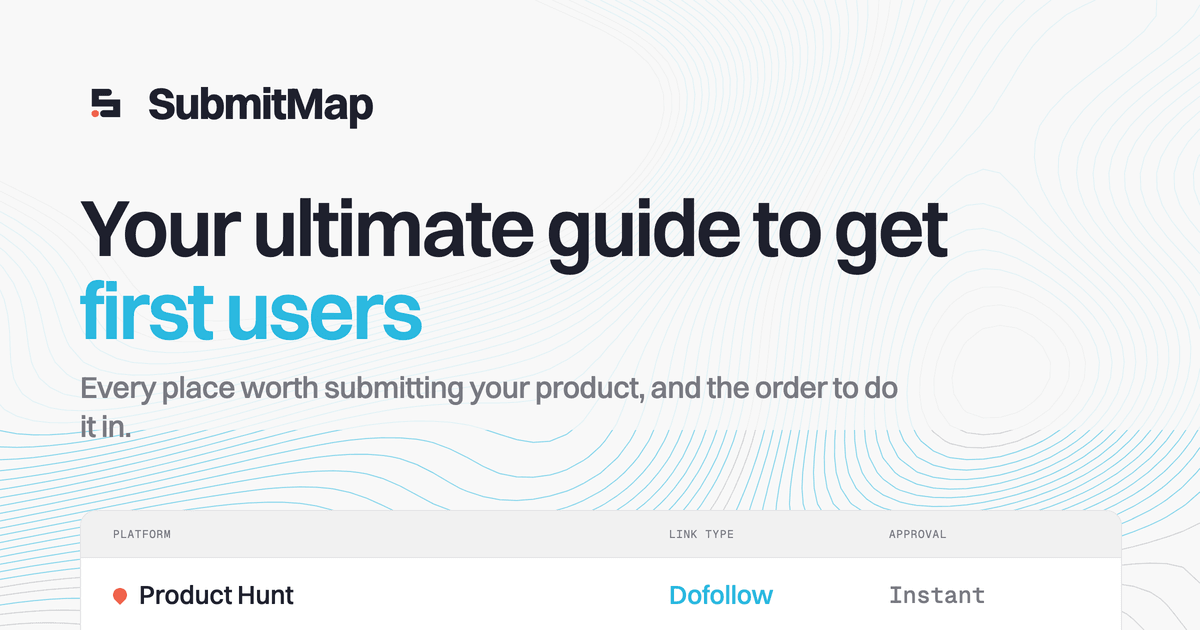
The 1200×630 card that renders every time anyone shares your URL. Some directories also use it as your listing cover. Export at 2× so it stays sharp on retina screens, keep the claim readable at thumbnail size, and put it in your site's head before you submit anywhere.
PNG · 1200×630
06The maker profile
You submit as a person, and half these platforms are social networks. Prepare the person too: a 400×400 avatar in both modes, a bio under 160 characters, and, for the launch platforms, the first comment, written before launch day, not at 6am during it.
- - The first comment tells the origin story the listing can't.
- - End it with a genuine question; comments are the ranking signal.
- - Same avatar everywhere, so people who saw you once recognise you twice.
- - Keep your X handle in the pack. Some forms make it required, and the listing prints it as the maker, so a handle borrowed to get past the validator credits a stranger.


Building SubmitMap: a free, editorial map of every place worth launching a product. No paid placement; usefulness is the moat.
@5thwye_
Hey everyone, maker here.
SubmitMap started as my own launch spreadsheet. Every time I shipped a side project I re-researched the same question: where do I submit this, and in what order?
So I turned the spreadsheet into a typed directory: every platform carries its eligibility rules, the exact form fields, the gotchas and the approval time. A phased route of guides puts it all in order, from launch-ready to your first hundred users. It also speaks MCP, so you can hand the whole thing to your AI agent and have it do the submitting in your browser.
The directory, the guides and the checks are free and need no account. There are paid plans for the dashboard and MCP if you want your projects and submissions tracked, and no platform pays for placement either way. I'd love to know which platform you'd add next.
07The recurring answers
Categories and pricing come up on every form. Decide them once: pick the three categories you would search for yourself, and phrase the pricing answer the same way everywhere, so your listings end up agreeing with each other, which both users and search engines notice.
08The whole pack as one text block
Everything above, flattened into the file you keep next to the assets. Paste it at the top of any form-filling session and every answer is already written. This is SubmitMap's actual one:
SubmitMap submission pack
URL: https://submitmap.com
Contact email: hello@submitmap.com

Tagline (55/60): Submit only where you qualify, and let your agent do it
One-liner: 800+ directories, who each one accepts, and an agent that submits only where you qualify.

Short description: SubmitMap lists 800+ startup and SaaS directories with the rules that decide who each one accepts: what gets rejected, the exact steps, approval time and dofollow status. Free to browse, no account. An agent then submits, only where you qualify.

Long description:
Every launch guide says "submit to directories". None of them say which ones accept your kind of product, what the form will ask, or what actually happens after you hit submit.

SubmitMap is that missing map, 800+ platforms and counting. Every platform is a typed record: who it accepts, what disqualifies you, the exact submission steps, expected approval time and whether the backlink is dofollow. The route organises it all into seven phases, from getting launch-ready to the paid channels you should only open last. Connect it to your AI over MCP and it works out what you qualify for and fills the forms in your own browser. It does not blast every directory: a submission you were never eligible for is just a rejection you waited a month for.

No paid placement, ever. Reading the directory needs no account; editorial usefulness is the whole moat.

Categories: Marketing, SEO, Developer Tools
Pricing: Freemium. The directory, guides and qualification checks are free and need no account. The dashboard and MCP are $9, $15 or $29 a month, $190 a year, or $250 once. No paid placement.

Maker bio: Building SubmitMap: a free, editorial map of every place worth launching a product. No paid placement; usefulness is the moat.
X handle: @5thwye_

First comment:
Hey everyone, maker here.

SubmitMap started as my own launch spreadsheet. Every time I shipped a side project I re-researched the same question: where do I submit this, and in what order?

So I turned the spreadsheet into a typed directory: every platform carries its eligibility rules, the exact form fields, the gotchas and the approval time. A phased route of guides puts it all in order, from launch-ready to your first hundred users. It also speaks MCP, so you can hand the whole thing to your AI agent and have it do the submitting in your browser.

The directory, the guides and the checks are free and need no account. There are paid plans for the dashboard and MCP if you want your projects and submissions tracked, and no platform pays for placement either way. I'd love to know which platform you'd add next.

Assets:
  https://submitmap.com/favicon.svg - Favicon (the bare mark) (SVG, square crop of the mark alone)
  https://submitmap.com/logo.svg - App icon (light) (SVG · 88×88 grid, 21px corner radius)
  https://submitmap.com/logo-dark.svg - App icon (dark) (SVG · same grid, dark tile)
  https://submitmap.com/logo-1024.png - App icon (light, raster) (PNG · 1024×1024)
  https://submitmap.com/logo-dark-1024.png - App icon (dark, raster) (PNG · 1024×1024)
  https://submitmap.com/og-default.png - OG / social image (PNG · 1200×630)
  https://submitmap.com/profile-400.png - Maker avatar (light) (PNG · 400×400)
  https://submitmap.com/profile-dark-400.png - Maker avatar (dark) (PNG · 400×400)
  https://submitmap.com/pack/gallery-01.png - gallery Opener (PNG · 1270×760)
  https://submitmap.com/pack/gallery-02.png - gallery The sequence (PNG · 1270×760)
  https://submitmap.com/pack/gallery-03.png - gallery Depth (PNG · 1270×760)
  https://submitmap.com/pack/gallery-04.png - gallery Close (PNG · 1270×760)
09Teach your agent to submit for you
This is the part other directory lists don't have. Connect SubmitMap to your AI over MCP and every platform comes with a brief written for its specific form, handed over with your pack's answers already in it rather than placeholders you fill by hand. The directory itself stays open, and the three tools that read it need no account, so your agent can check the eligibility rules and skip the platforms that would reject you before you sign up for anything.
Paste this brief into your agent, drop your pack from step 08 at the bottom, and it works through every submission you qualify for, in your browser. You review and hit send.
You are submitting my product to launch directories.

My submission pack is pasted below. It is the single source of truth
for every answer; do not invent copy.

1. Use the SubmitMap MCP server (https://submitmap.com/api/mcp). If it is not
   connected, stop and tell me: setup is at https://submitmap.com/docs/setup/.
2. Call create_project with my pack, then qualify_project. Show me
   what is ready now, what is one missing piece away, and what is out
   of reach, with the rule behind each.
3. Answer the two questions it asks about the run, whether the product
   is out already and whether I will pay to be listed, then work the
   recommended order it gives back rather than one of your own.
4. For each, call submission_playbook and work from what it returns:
   the preflight, the field values, the steps, the gotchas. Fill the
   form in my browser and stop for me at any sign-in. Then log it with
   record_submission before starting the next one.

My pack:

{PASTE YOUR PACK TEXT BLOCK HERE}
More on the agent-facing endpoints, including llms.txt and the full-content feed, on the for-agents page.
Submission pack questions
What is a directory submission pack?
What size should launch gallery images be?
What is the character limit for a Product Hunt tagline?
Can an AI agent submit my product to directories for me?
Do I need different logos for different directories?
Pack ready? The directory tells you where to paste it, and the route tells you in what order.